

BY TED SHOCKLEY, Eastern Shore Post —
There were many military airplane crashes on the Eastern Shore in the 1940s and 1950s, some of them involving fatalities.
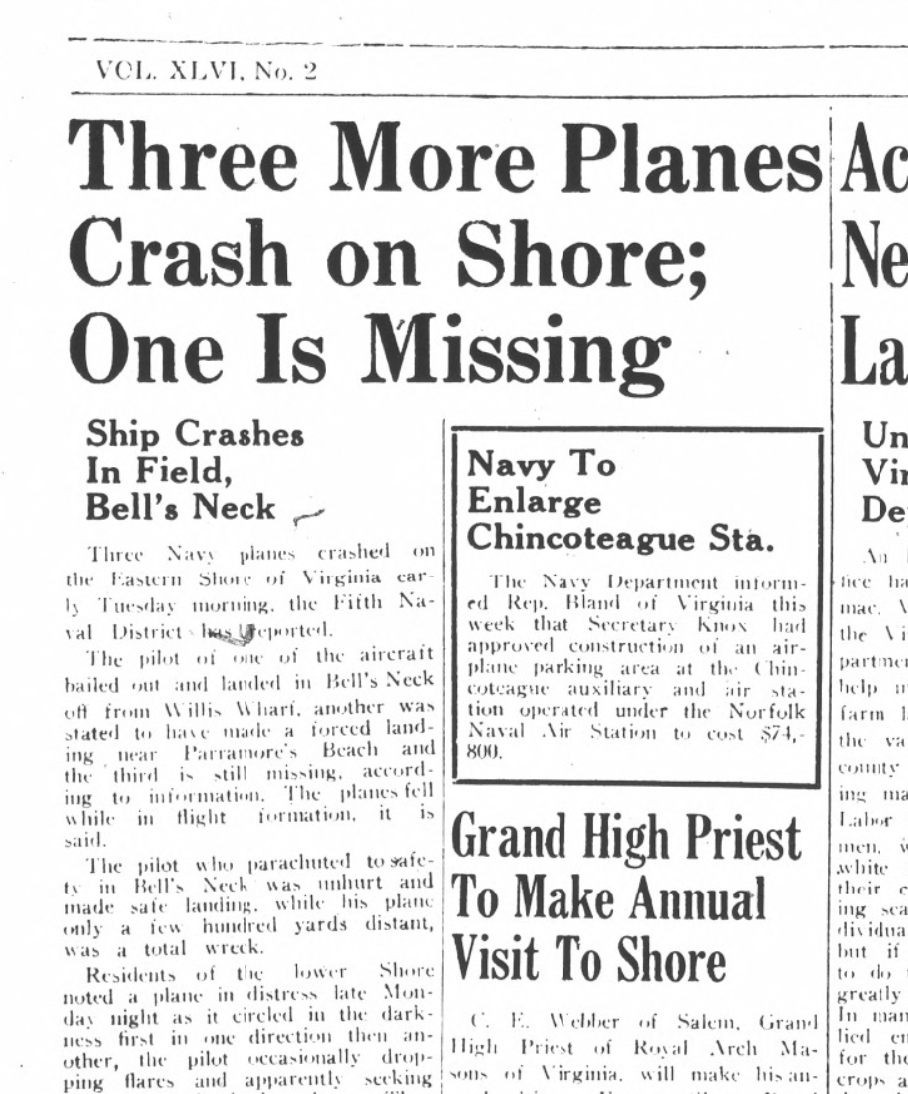
On May 31, 1943, three planes crashed on the Eastern Shore that “fell while in flight formation,” the Eastern Shore News reported.
One of the pilots parachuted to safety in Bell’s Neck, north of Willis Wharf. His plane crashed nearby.
The second “made a forced landing” on the beach at Parramore Island.
The third airplane was missing altogether. Its pilot, U.S. Navy Reserve Ensign Sidney Carol Claiborne, a native of Texas, also could not be found.
Almost two weeks later, Claiborne’s body washed ashore on Parramore Island. Some airplane wreckage also was found.
The other two pilots were not injured.
The remains of Claiborne, 21, are interred in a Lubbock, Texas, cemetery.
n On June 5, 1945, a pilot stationed at the Chincoteague Naval Auxiliary Air Station crashed the airplane he was flying near Stockton, a Maryland town near the Accomack County border.
U.S. Navy Lt. Robert Harold Anderson, 26, resided with his wife in nearby Public Landing when he was killed.
An article in The Daily Times newspaper of Salisbury, Md., stated Anderson’s airplane went down three miles northwest of Stockton on a farm owned by Herman Trader.
“When the plane hit the ground, it burst into flames and burned with the pilot trapped in the cockpit,” the newspaper reported.
A native of Eau Claire, Wis., Anderson’s gravesite also is there. In addition to his wife, he also was survived by a daughter who had not reached her second birthday.
Anderson had recently returned from the Pacific theater in World War II.
n U.S. Marine Corps 2nd Lt. Vernon Lee Somers, 29, of Bloxom, was killed in action June 6, 1918, during World War I in the Battle of Belleau Wood, in France.
He posthumously earned the Distinguished Service Cross and the Navy Cross — the second-highest military decoration for Marines.
Somers was a member of Virginia Military Institute’s Class of 1915.
A Roanoke Times article from June 20, 1922, recounted that Somers was wounded several times during the battle and told stretcher-bearers carting him away to put him down.
“I am dying, and I want to die with the boys,” the newspaper reported Somers saying.
His last words were, “Stay with them, boys, and show them where you come from,” the paper reported.
His remains were interred in April 1922 at the Parksley Cemetery. An article in the Peninsula Enterprise newspaper called it “the largest crowd in many years” at Bethel Baptist Church.
“It was reported that 3,000 people were at the burial,” the newspaper reported.
The Oct. 4, 1919, edition of the Peninsula Enterprises contains short biographical sketches of the Eastern Shore’s World War I fatalities and shows Somers to be among the area’s honored soldiers.
After graduating from VMI, Somers served as commandant of Georgia Military Academy, according to the biographical account written by the Rev. R. S. Monds.
He resigned the position to take the U.S. Marines physical, but he failed it twice because of “defective eyesight,” Monds wrote. The third time he passed.
“His spirit lies among us today in the principles for which he died and these principles, dear to our hearts, shall ever live,” Monds wrote.
n U.S. Army Pvt. 1st Class Clarence William “Buddy” Bloxom, of Parksley, was 26 years old when he was killed in action on June 6, 1944 — D-Day — at Omaha Beach, Normandy, France.
Bloxom was a member of the 116th Infantry, of which 800 were classified as dead, wounded, or missing.
Bloxom’s remains arrived back in the United States in late 1947 and a funeral was held Dec. 21 of that year.
His remains are interred in the Parksley Cemetery.
n U.S. Army Pvt. Hugh Franklin Williams, 19, also was killed on D-Day when the aircraft on which he was a passenger was shot down and crashed in northwestern France. Williams, a Tangier Island native, was a member of the 506th Parachute Infantry, 101st Airborne Division.
Williams, a paratrooper, was among 20 servicemen who died in the crash.
Williams’ name is on a headstone with two other servicemen on the fatal flight in the Long Island National Cemetery in New York.
n U.S. Army Pvt. Vandyke S. Toye, of Accomack County, died June 10, 1945, during World War II.
He served with the 388th Engineer General Service Regiment, which had Black soldiers.
Toye was Black and there is no mention of his death in the Eastern Shore News or Peninsula Enterprise newspapers.
Toye’s remains are interred at the Normandy American Cemetery and Memorial, Colleville-sur-Mer, France.
n U.S. Army Pfc. Ernest W. Henderson, of Cheriton, died June 11, 1953, during the Korean War.
I have found little about Hender- son, who was Black. A newspaper account after his death identified his mother as Mary E. Bell.
It is unknown how old Henderson was at the time of his death. His birth year was 1925 but records do not show the date of his birth.
The article stated his body was one of 198 war fatalities carried back to the United States aboard the USS Sharon Victory.