


BY CAROL VAUGHN
Eastern Shore Post
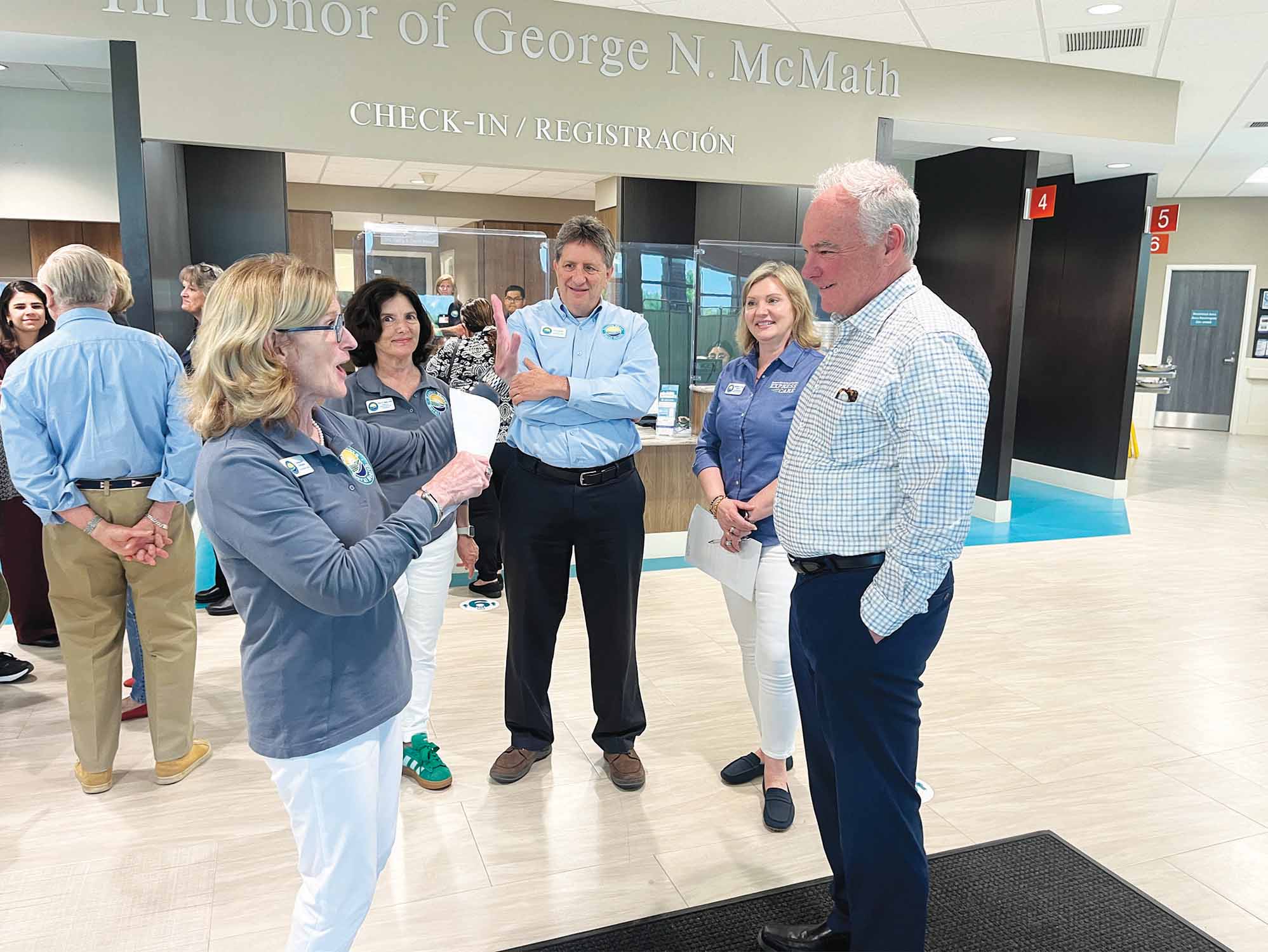
U.S. Sen. Tim Kaine visited Eastern Shore Rural Health System’s Eastville Community Health Center Tuesday to hear from staff and board members about rural healthcare access, the effects of recent cuts to Medicaid, and reforms to the 340B drug pricing program.
Kaine also took a tour of the facility, which provides medical, dental, and behavioral health services.
“Our goal is just to check in, hear how you are doing,” Kaine said, adding that part of his purpose in visiting is to “gather intel, because I am trying to convince my colleagues that some of the Medicaid cuts that were put into the budget … went too far.”
The cuts will strip health insurance from around 323,000 Virginians and gut federal funding for rural hospitals, according to Kaine.
Even though most Medicaid cuts are targeted for the end of this year and 2027, “We are already seeing pretty significant effects,” including the shuttering of three Augusta Health primary care clinics and cuts at Valley Health, in addition to the closing of the labor and delivery unit at Central Southside Community Hospital in Farmville, Kaine said.
Kaine also spoke about reforms to the 340B program, noting he is one of six senators working to draft them.
The 340B program, which requires manufacturers to provide outpatient drugs to eligible safety-net healthcare providers at reduced prices “is really a good program,” Kaine said, but he noted the program has grown “exponentially faster than we might have expected and there have been some abuses,” where providers “weren’t necessarily really providing a lot of safety-net care.”
He acknowledged the program is important to rural providers like ESRH and said the committee wants input about proposed reforms.
“They have to work for the FQHCs (Federally Qualified Health Centers),” Kaine said, calling the centers “really the core constituency … in terms of whether the 340B program meets what it was intended to meet.”
Kim Savage, ESRH’s chief compliance officer, said having in-house pharmacies helps with compliance “because we can ensure that our patients can get their medication.”
The savings from the program “allows us to provide all these services,” such as diabetes education and more, she said.
Eastville was one of three stops Kaine (D-VA), a member of the Senate Health, Education, Labor, and Pensions Committee, made around the state this week to talk about healthcare and job training.
Rural Health Chief Executive Officer Jeannette Edwards noted the healthcare system is celebrating its 50th year and recalled that Kaine when he was governor had cut the ribbon on the former Onley Community Health Center, which now is ESRH’s corporate office.
“He is a true friend of Eastern Shore Rural Health and he’s always one we know we can call,” Edwards said.
ESRH has grown since from one site to 13, she noted.
Edwards also thanked Kaine for his help getting federal funds for dental services at Occohannock Elementary School, which recently marked one year.
Still, Edwards said while no services at ESRH have been impacted as yet as result of the Medicaid cuts, “We can not make a budget because of what is the unknown out there.”
She said ESRH “is very conscious of compliance with executive orders,” even if its staff does not always agree with them.
“We get $5.2 million in grant funding and we cannot afford to lose that for our patients,” she said.
Edwards said ESRH is particularly concerned about new work requirements for Medicaid recipients and the resulting administrative burden on providers, with many regulatory details not yet defined.
“Right now we have to check everybody every 12 months, and it is going to go down to six from 12 months — we know that. What we don’t know is, what are the final definitions — medically frail, mandatory versus optional, standardized care, enforcement — how are we going to enforce it.”
The regulations go into effect Jan. 27, 2027, making it urgent to get answers, she said.
“We’ve got a team that is reading the information, trying to find out, constantly going online, we’re constantly calling — and we are looking, but we are not getting the answers that we need.
“It is making it difficult for us to plan for the next year, to run an organization. Who do we hire? How many do we hire?” Edwards said.
Brooke Lusby, ESRH’s financial officer, said some patients have financial challenges that result in them not being able to pay for their post office box or cellphone minutes, which will make it even harder to get the mandated information.
“The people that this will hurt the most are the most needy,” Kaine said, citing people experiencing homelessness as an example.
Lusby said the percentage of Medicaid-insured patients has decreased and the percentage of uninsured patients has increased significantly in the last two years. “It’s a trend, so we are concerned about that.”